The Last Hellion--The Interview

HISTORICAL NOVELIST SUSAN HOLLOWAY SCOTT TALKS TO ME ABOUT THE REISSUE OF THE LAST HELLION

SUSAN: As a reader and longtime Loretta fan, I’m personally delighted to see THE LAST HELLION returning in a fresh package for new readers to discover. Would you tell us a bit about the story?

Cribb vs molin 1811

LORETTA: This was one of the cases where a secondary character intrigued me. The Duke of Ainswood makes a brief drunk and disorderly appearance in LORD OF SCOUNDRELS. That was all he was supposed to do. But he kept bugging me. What was his problem? What was he covering up or running away from? It turned out that the Duke of Ainswood is a drunken boor because he’s paid an unbearably high price for his position. But his brand of self-destruction takes him slumming--and puts him on a collision course with big, blonde, and dangerous Lydia Grenville, crusading journalist (and secret romance writer). This story is special to me because it was an opportunity to deal with some aspects of Regency life that one doesn’t encounter often in historical romances. It was a way of getting into that Dickens world I love so much while allowing both my characters to try to fight the good fight--along with fighting with each other and falling in love.

The Last Hellion

I’m terrible at summarizing my stories, so I’ll let readers look at the back cover blurb here and an excerpt here.

SUSAN: Lydia Grenville is an untraditional heroine, nearly six feet tall, nearly thirty, and full of fire and conscience. She’s also a “career woman” in a time when ladies didn’t work, let alone work as crusading journalists. What inspired you to develop her character?

PyramidDatePalms

LORETTA: Dickens gave me the general inspiration for the setting, and the novels he and others wrote in serial form gave me the idea for her pseudonymous ROSE OF CAIRO. But more important, Lydia is one of the many woman characters I’ve created in reaction to women in 19th C novels and to 19th C sexism and misogyny in general. Specifically, what set me off was critics’ reaction to Lady Morgan’s two-volume ITALY. You can read her response to some of the criticism here.

LadyMorgan

According to Paul Johnson’s THE BIRTH OF THE MODERN, “they hated Lady Morgan as a woman writer...and they were further incensed by the news that the publisher Colburn had paid her the immense sum of £2000 for the book. Byron hailed the book as ‘fearless and excellent.’” Everyone else went nuts. Here’s a sampling from Johnson’s book: “‘she spewed out of her filthy maw/A flood of poison, horrible and black. “She was ‘an Irish she-wolf’ a ‘blustering virago,’ a ‘wholesale blunderer and reviler’; she wrote while ‘maudlin from an extra tumbler of negus in the forenoon.’” This was typical “criticism” of the time--reviewers today are pussycats by comparison. What fascinated me me was the how much they hated her simply because she was a successful woman writer.

His Girl Friday

It was a tough world, and journalism then was definitely no place for a lady. So I got the idea of a heroine who was both a tough cookie journalist (a HIS GIRL FRIDAY kind of dame)--and a writer of highly popular romantic tales. And the two occupations reflect the two sides of her personality.

Coffee Shop at Olympia

SUSAN: While Lydia is unusual, her hero, Vere Mallory, Duke of Ainswood, outwardly seems that most stereotypical character, the rakehell peer. But it only takes a few pages for readers to see the only typical thing about him is that he’s one more in a long line of deliciously unforgettable (and irresistible) heroes. What makes him so special?

Blue Ruin-Cruikshank-g

LORETTA: Well, he’s a big, dumb jerk, for one thing. I love writing tough, smart, cool heroes like James Cordier of YOUR SCANDALOUS WAYS or Lord Rathbourne of LORD PERFECT. But the Regency had its cowboys, too, and creating those types of heroes (Rupert of MR IMPOSSIBLE is one of my cowboys) is a different kind of challenge, and a different kind of fun. Sometimes I think we have an overly refined image of what men were like then. There’s a great passage in Conan Doyle’s RODNEY STONE: “He was a type and leader of a strange breed of men which has vanished away from England--the full-blooded, virile buck, exquisite in his dress, narrow in his thoughts, coarse in his amusements, and eccentric in his habits.” The “coarse in his amusements” concept influenced heroes like Lord Dain and the Duke of Ainswood.

Peep o Day boys-Cruikshank-g

Another inspiration for this story and his character was Pierce Egan’s LIFE IN LONDON. I could easily picture Ainswood in the situations Cruikshank illustrates.

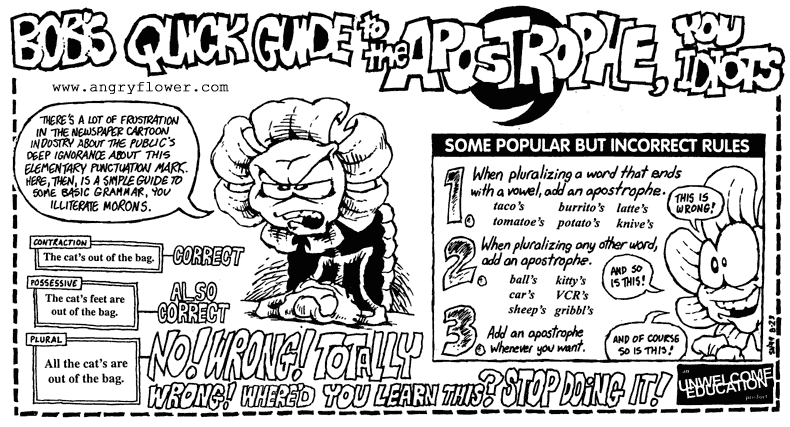
The Angry Apostrophe

Black_lace_barbie

I recently learned that 24 September is National Punctuation Day. In honor of the occasion--which coincides nicely with my recent blogs dealing with Annoying Errors, I thought we could talk about those interesting squigglies and dots and dashes we use to help readers understand what we mean.

In my last blog, I indicated that one way to get a group of authors ranting and raving was to bring up the subject of copy editors. Among other things, a copy editor is supposed to check our punctuation. For some reason, copy edit changes used to disturb me far more than editorial changes. I would go ballistic when a copy editor removed or added a comma, yet not even blink when an editor suggested I delete three chapters.

Virago

It must be some kind of mental condition. That would explain why I still twitch when I remember a very weird set of mistakes in at least one volume of Byron’s Letters and Journals. Throughout, it’s was used where its should be and vice versa. It drove me insane.

Yswfrontsm200dpi

I know Byron was clueless about punctuation. He admitted it. I know a dash tended to be his universal punctuation tool--but he did dash very dashingly, we must admit. I can understand his failing to master the art of commas, semi-colons, and colons. An apostrophe, however, is sort of a spelling tool, isn’t it? It marks contractions. And he seemed to understand this aspect of punctuation..sort of...or was that his editor? He uses tons of contractions. They appear in practically every piece of his poetry I quoted in Your Scandalous Ways. Here’s a sample from Beppo.

Didst ever see a Gondola? For fear

You should not, I’ll describe it to you exactly:

‘Tis a long cover’d boat that’s common here,

Carved at the prow, built lightly, but compactly;

Row’d by two rowers, each call’d ‘Gondolier,’

It glides along the water looking blackly,

Just like a coffin clapt in a canoe,

Where none can make out what you say or do.

Life_in_london_pg

Yes, he had his own unique style but his grammar was fine and his spelling no weirder or more inconsistent than others of his time. It seems bizarre that he got it’s and its backwards consistently. I can’t help thinking those errors were not in the original letters but were committed by a typist, copy editor, or printer and somehow went through the whole production process without anyone realizing--or with everyone thinking that’s how he did it.

I’ve always wondered why it’s and its confuse anybody, but they clearly do because I see it all the time, including in newspapers. Is it because English teachers don’t drum it into kids’ heads early and often enough? It’s one of those things, like the use of lie and lay, that need to be drummed in because it’s easy to get confused. In English we form possessive pronouns differently from the way we form other possessives, e.g., “Pavarotti’s voice was distinctive” but “its engine was broken.”

Chicago_manual

However, while I can--sort of, and with sorrow in my heart--understand how apostrophes get misplaced, I have never figured out how apostrophes got into the plurals business--as in “Banana’s 89¢ a pound” or “keeping up with the Jones’s.”

Here is one approach to explaining the correct way to use apostrophes. Here's a politer version of same. And here are many examples of punctuation abuse.

A few years ago, Lynn Truss got so exasperated with stupid punctuation that she wrote a book, Eats, Shoots and Leaves, about it. Funny thing is, the book’s got some...um...punctuation errors. Louis Menand, in the New Yorker (28 June 2004), reviewed her book, and suspected it was a hoax, because the errors, he said, started in the dedication and continued with gay abandon throughout the book.

In Jasper Fforde’s alternate reality novel, The Eyre Affair, a form of specially engineered bookworms (as in actual larval things, not nerds--and I cannot possibly get into the technical capabilities of these bookworms) excrete apostrophes. That would explain the wretched excess.

Here's one proposed solution to apostrophe atrocities: abolish that little squiggle.

Fowler_the_kings_english

I don’t agree. I’ve devoted my life to the English language, trying to master its intricacies. Punctuation, grammar--all those dull, technical matters to me are part of the big game of exploring the expressive possibilities of a remarkably elastic language. To eradicate a punctuation mark is like eliminating, say, metaphors. Yes, it would make things simpler, but should language always be simple? A straight line is the shortest distance between two points, but it’s not necessarily the most beautiful route.

Merely my opinion, of course, but when the technical niceties of language are under discussion, people can get very...intense. In the words of Randy Newman, "I could be wrong...But I don't think so." And I think he speaks for all of us.

Originally posted at Word Wenches.

Mea Culpa

From Loretta:

Black_lace_barbie

A reader asks:

“I know that once a story is submitted to the editor, it goes through a series of proof-reading and corrections, reworking storylines and editing. Why is it that after all that work some of these mistakes are still found in the story? Do the authors not keep vitals on their characters in order to keep his/her description accurate all through the book?”

It's alarmingly easy for authors to make mistakes. Including really horrendous, ridiculous ones. I speak from experience.

Notes

I research the daylights out of my subjects. I keep spreadsheets of character names, physical descriptions, dates of birth, dates of important events, and historical data. I keep a notebook of facts and details I need to check. A phrase in Chapter 2 might be too modern. I’ve changed a character’s hair or eye color or name or age part way through the story. I need to find out where a shop is. I make a note in the notebook and go back to the WIP.

Dictionary_of_the_vulgar_tongue

I do this because stopping to correct these kinds of details while in the process of writing disrupts my concentration, mood, and the story’s flow. Because I revise so much while writing, it’s usually better to reserve the detail work for later in the process, when I’m cleaning up the manuscript before submitting it. But sometimes, in the frenzy and exhaustion of Deadline Hell, I miss one of my notes, and the mistake appears in print, to annoy readers like Jaclyne, who wonders how this can happen, when so many pairs of eyes review my work.

Chicago_manual

Mistakes with eye or hair color or other vital statistics are the kind someone really ought to catch, same as they ought to catch a writer's using, say, "flaunt" when the correct word is "flout," or a comma where there should be a period, or a missing end quote. If I’m such a babbling idiot by Deadline time as to miss an obvious mistake, a copy editor ought to catch it, and most will. But I’ve never had the same copy editor twice, and as is the case in all professions, some are sharper than others. (Along with covers, the subject of copy editors is one guaranteed to get a group of authors very excited. And not in a good way.)

1817accidentsinquadrilledancing_2

When it comes to historical detail or foreign languages (for Yanks, the latter would include British English), it’s mainly the author’s responsibility. And this author, though a nerd, ALWAYS makes at least one mistake per book. It’s not that I don’t care. I drive myself & others crazy with the obsession to Get It Exactly Right. Yet inevitably, there are errors. Because Nobody’s Perfect. (For the best use ever of this phrase, please see Some Like It Hot.)

Lord_of_scoundrels_07sm_3
Articles

I could do a whole blog--or several--on the pitfalls of historical research, but foreign languages allow for an easy demonstration of the If You Don't Know It's Wrong, How Do You Know It's Wrong principle.

A few years ago I found out that there were a few errors in the Italian (pronouns and gender errors) in Lord of Scoundrels. This happened despite my consulting books as well as people who spoke and wrote Italian. Trouble was, I did not realize how difficult and complicated Italian was--trickier grammatically than French, for instance. I did not know that the book I relied on was inadequate. Neither I nor my consultants realized my queries to them should have been more detailed. What I needed was an experienced professional translator, but I didn’t know enough to know this.

Americanisms_3

I cannot expect editor and copy editor to catch Americanisms (i.e., words or phrases the English wouldn’t have used) or anachronistic language. So no, I can’t expect them to catch errors in every single foreign language that appears in my books--like Arabic as understood by English speakers in the 19th C (for Mr. Impossible).

Jaclyne says, “It sometimes annoys me to find these in the books I read, thinking that if I found them, they should have been easily corrected in the editing process. It makes me think I should become a proof-reader... seems to me the ones that are supposed to do the job are only skimming the story, not reading it, and so, not doing their job properly.”

That may be a little harsh. True, I and other authors have discovered errors introduced by others during the editing/copyediting/proofreading process--and not corrected, despite our protests. We’ve also discovered mistakes that every single person reviewing the manuscript somehow overlooked. But we definitely can't expect those reviewing to be omniscient. We’ve all made mistakes, I think, for which we can blame no one but ourselves, and all we can say to readers is, Mea Culpa.

Criminal

(Originally posted at Word Wenches)