The Two Nerdy History Girls & the World of 1776—Now On YouTube

Clockwise from upper left: Loretta Chase, Meena Jain, Susan Holloway Scott

As always, Susan Holloway Scott and I had a wonderful time with Ashland (MA) Public Library Director Meena Jain. This time, the Two Nerdy History Girls did something a little bit different: We focused on Revolutionary War era America—and along the way, did some compare & contrast work with several topics. As you probably are well aware, everyday life in America, before as well as after the revolution, was different from life in England in many ways.

Susan has written several works of historical fiction focusing directly on Americans during the Revolutionary War era, whereas my focus has been early nineteenth-century England. Still, I’ve learned some things from my visits to Colonial Williamsburg, and this, I hope, helped me keep up with the questions.

For those who missed the conversation, or who’d like a rerun, here’s the YouTube link.

The hour went by quickly. Since some of the information might have slipped by the audience, and since I have (of course) more historical nerdy-ness to offer, below are some of the books mentioned as well as links to additional information.

Here are some of the 2NHG posts on pins:

Pins & Pinning

As Used by Jane Austen: Pins, the Regency Post-It

A Young Woman Dresses for Day, c. 1775

Colonial Williamsburg offers many videos about life in 1700s America.

If you want to learn more about Colonial fashion, a number of videos show how clothing was made and how people dressed.
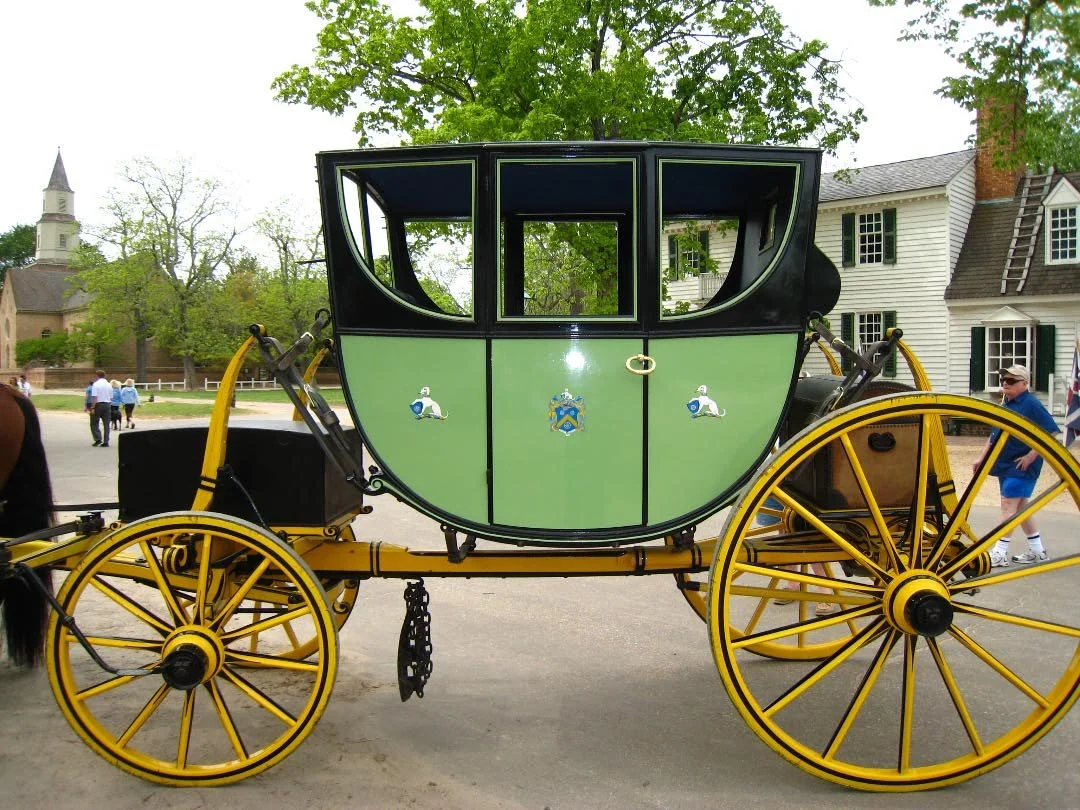
Coach at Colonial Williamsburg

When we discussed transportation, I referred to an early 19th century book, The Traveller’s Oracle (2 volumes), which covers, apparently, every detail of traveling in England in the 1820s. By this time, England had vastly improved its roads, with a corresponding increase in inns, but the basic principles would apply to most people traveling via horse or carriage.

Kensington Palace Part Two

Gates of Kensington Palace, 2017

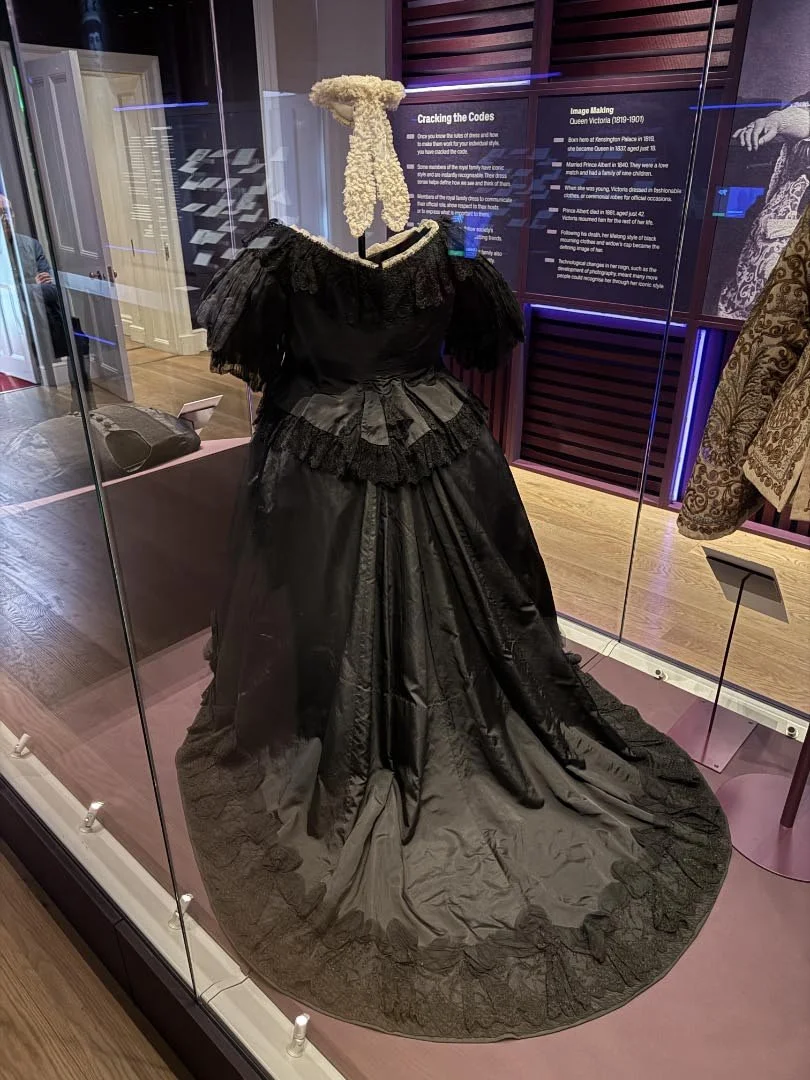
My previous post focused on Queen Victoria’s childhood. Though she left Kensington Palace as soon as she could after becoming Queen, its displays do offer glimpses of her adulthood.

The portrait of her at the theater, in the year she ascended to the throne, was new to me, and I absolutely love it. This is not a shy and retiring young woman. Though she’s only eighteen, she absolutely knows who she is. She needed to be strong-willed to get to this point. As Gillian Gill puts it in We Two, “while the Princess Victoria was weak , feverish, and confined to bed, Conroy and the duchess tried to browbeat her into signing a document appointing Conroy as her personal private secretary in the event of her accession to the throne.” She was only sixteen at the time. She refused to do it.

If you’d like a sharper image, which you can zoom in on, the portrait of Victoria wearing the emerald set is here at the Royal Collection Trust.

Below are a few notes on the photos of other items on display at Kensington Palace.

Mourning dress had specific stages, with the later stages allowing for a few colors. For the rules in Queen Alexandra’s time, you might want to take a look at these pages of Manners and Rules of Good Society (1913 ed).

The diamond tiaras speak for themselves.

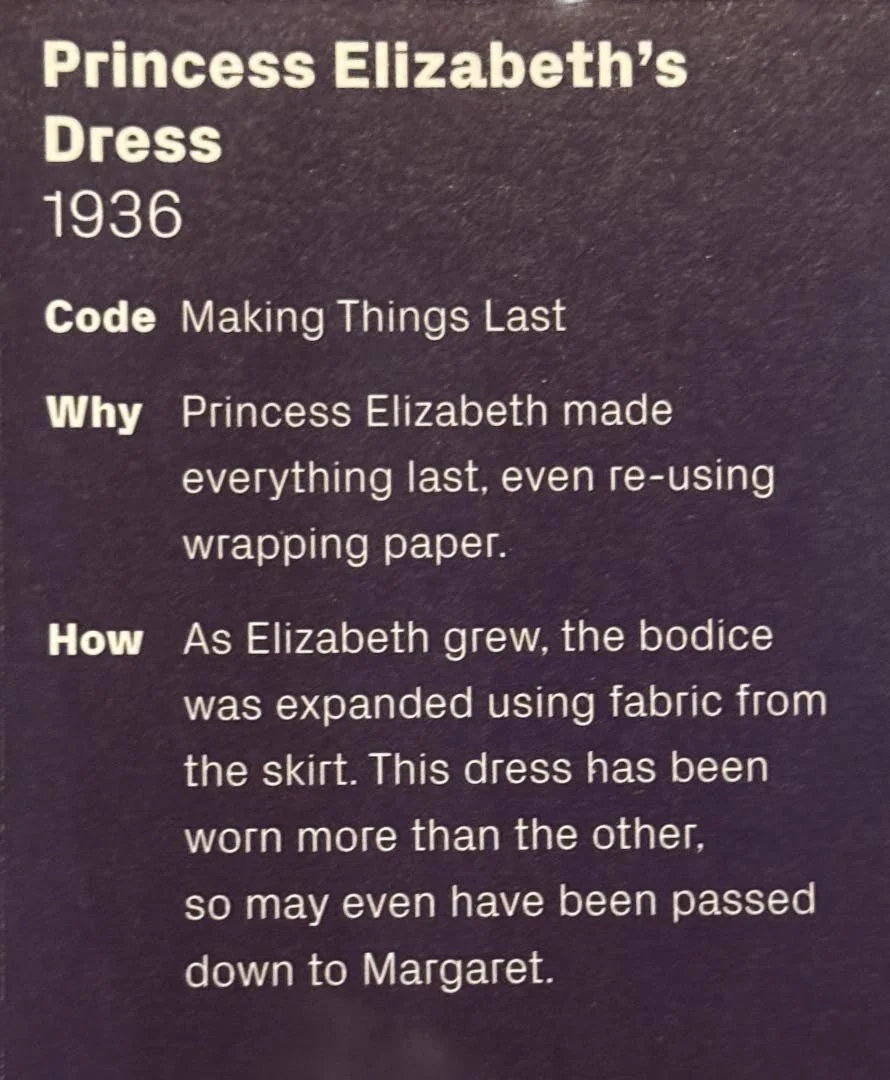
We’ve all seen so many photos and films of Queen Elizabeth in her girlhood, but it was an altogether different and enlightening experience to see her and Princess Margaret’s dresses, and to learn that they were altered in order to last a long time.

Court dress is something I’ve mentioned in a few books. It did not always keep up with fashion, or else did so with its own special rules and additions. The gentleman’s court suit of 1780 is a good example of the level of expenditure. Even the detail shots can’t fully convey the richness and sparkle. The men gathered at the Court of St. James must have been quite a sight, no doubt vying with the ladies for splendor. Not that the ladies faded into the background. Their dresses would be embellished with diamonds, pearls, and other precious gems. The Lord Chamberlain, on the monarch’s orders, would issue rules about court dress, and these could change. However, ostrich feathers, lappets (those lace things dangling from the back of the headdress), and trains continued into the 20th century, as the 1928 dress shows. This painting of Queen Adelaide’s 1834 Birthday Drawing Room gives a good idea of a Court gathering at the time of my recent stories.

I’ve included the short video of Lady’s Holcroft’s court dress because a still photo simply doesn’t do the job. You can find several photographs of Lady Holcroft in her court dress here at the National Portrait Gallery. If you are unable to view the reel in your email, you can view it here on my website blog.

A short video of Lady Holcroft’s court dress

What they wear in "My Inconvenient Duke"

Margaret Sarah Carpenter, Portrait of Lady Harriet Georgiana Brudenell (1799-1836), married Richard William Penn Curzon-Howe, 2nd Viscount Curzon (later 1st Earl Howe) in 1820. Portrait date 1834.

I’ll be the first to admit that 1830s women’s fashions are baffling and not necessarily attractive to 21st century eyes. But for a writer, they offer solid gold material. The male characters marvel at what the women are wearing, although these men are mainly preoccupied with a strategy for getting the lady out of the clothing. And if a man gets lucky, and gets to test his strategy, the process makes for fun, because there are so many layers, and one must deal with tapes and buttons and hooks and eyes. Oh, and those sleeve puffs, too.

As I’ve mentioned more than once, I also like the way women made themselves so big with these ensembles—not simply the big sleeves and swelling skirts, but also their hair and their headwear. The 1700s had big hair, and so did the 1980s, but the knots and rolls and swirls of the 1830s are something else altogether. It’s amazing what they could do without our blow dryers and gels and pastes and lacquers. Instead, it’s pomatum (aka pomade, and made of grease of some kind and natural scents) and pins and various hairpieces. There’s nothing shy and retiring about these fashions. And none of the “less is more” way of thinking. It’s “more is more.” And I find it fascinating and stimulating.

Of course, when you read, you’ll picture the clothing in a way that’s appealing to you—and that’s as it should be. Reading let us use our imagination.

Even when I write descriptions, I usually keep details to a minimum. This is partly not to slow down the story but also to allow readers to make the mental image they want. For instance, in Chapter 2 of My Inconvenient Duke, Lady Alice wears “a redingote of deep onyx.” That’s it. Not that I’ve been able to discover where that came from. After searching my numerous books and the images on my hard drive, I’ve begun to suspect that I made it up or created one dress from a couple of fashion descriptions.

But a redingote is, basically, a close-fitting (from the waist up) dress that fastens all the way down the front, like a coat. And the color onyx is not mysterious, unlike so many other fashionable color names one encounters.

In the gallery below you’ll see most of the clothing mentioned in the book. Many of the images will be slightly distorted. This is because I photographed them from my copy of the 1832-33 The World of Fashion, in which the monthly magazine is bound. It’s very old, very thick, and I don’t have the right (i.e., expensive) kind of scanner for this kind of work.