
Lord of Scoundrels & the Coaching Inn

In January, we celebrated the 20th anniversary of Lord of Scoundrels' publication.  This gives me a good excuse to explain some of the references in the story.  You can also find images on my Pinterest page.  Below is s a blog I did for Two Nerdy History Girls about coaching inns, so you'll have an idea of what Jessica & Dain were looking at.

*

Those of us writing books set during the coaching era often puzzle over coaching inns.  Even when we actually visit coaching inns in England, we may not feel enlightened.  We don’t see the horses or the stablemen.  The once-bustling yard is often converted to an eating area, with picnic benches and flowers.  Sometimes the interior has been redone to look more ye olde than is quite authentic.  Here’s the basic layout, courtesy H.D. Eberlein & A.E. Richardson, The English Inn Past & Present.

~~~

Custom had decreed the arrangement of an inn plan.  There was the usual courtyard with its arched or beamed entry.  There was a hall for receiving guests, a main staircase, a coffee room and a dining parlour.  Some inns could boast a special apartment for dining coach passengers only.  In addition there were smaller apartments known respectively by the names Sun, Moon, Star, Crescent or Paragon.  From 1700 to the year 1760 the arched entries were low, for until the latter date outside passengers were not encouraged.  After the accession of George the Third, when outside travelling became more general, the inside passengers were treated as belonging to an inferior order.  Not only did landlords show increased respect to the outside passengers, but a subtle compliment was paid to the coach proprietors by the landlords when alterations to the arched entries were made to their respective inns.   ...

No definite system of planning seems to have been adhered to through the centuries for inns other than to provide a yard around which were grouped sets of lodgings and a further yard for stabling and wagons ... The old inns of London consisted in the main of a block facing the street with an entry to a courtyard within, the front part of the house being reserved for sitting-rooms and eating parlours. The problem of the Georgian buildings was to provide easy ingress though an arched entry for coaches, which made their way out through a gate in the further yard.  To right or left of this entry, which varied according to circumstance, there was generally a large room where coach passengers could dine; to the left was the coach office and a passage connecting with the bar and the coffee room.  The drawing room was on the first floor.  This arrangement was generally followed in all parts of the country.

~~~

Images:  Pollard, Hatchett’s, the White Horse Cellar, Piccadilly (from which my hero and heroine set out in Scandal Wears Satin).  From Denver Art Museum collection.  T.H. Shepherd, The Old Bull & Mouth Inn, from London and Its Environs in the Nineteenth Century (1831 ed), courtesy Internet Archive.

 

Isabella Bradford Guest Post: Where Do I Get My Ideas?

In the second of what I hope will be a continuing series of guest posts, my friend/blogging partner/fellow historical romance author, Isabella Bradford, talks about the inspiration for her latest release, A Sinful Deception.  (Reader, I've just finished it, and can promise you a poignant, suspenseful, and extremely romantic story set in the gorgeous Georgian era.)

Welcome, Isabella!

***

Many thank to my BFF and fellow Nerdy History Girl Loretta for inviting me here to write a guest post for her blog. Loretta and I talk – a lot – and when it’s not the usual stuff about gossip, shoes, and food, we will marvel (and curse) at the mysterious process of writing. Between us we’ve written scores of books, and yet we still don’t have a clue how exactly the whole creative process works.

Take, for example, that age-old question posed to writers: where do you get your ideas? The smartie-smart reply is “Why, I get then discounted at Ideas.com!”, but the real answer makes about as much sense. We don’t know. Ideas just appear, or not, and there doesn’t seem any reasonable way to predict how, why, or when.

Take my newest historical romance, A SINFUL DECEPTION (on sale everywhere now, in paperback, eBook, and audio book). I’ve always wanted to write a book that includes not just Georgian England, but the farthest corners of the British Empire. My heroine, Serena Carew, was born in India, the daughter of a English nobleman stationed there. While Serena has spent most of her life as an English lady, her Indian heritage is impossible for her to forget – and it’s also one of the things that Lord Geoffrey Fitzroy comes to love most about her.

This heroine has been in my head for a long time. I didn't quite realize how long, however, until I started thinking about this blog post.

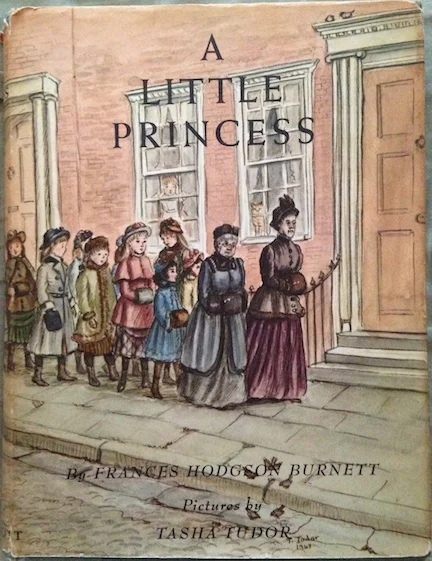
For my tenth birthday, I was given a copy of A Little Princess by Frances Hodgson Burnett with illustrations by Tasha Tudor, first published in 1880. I know that precisely because I still have the book, and it's inscribed with the date and occasion. It instantly became one of my favorites, and still is. I have a great deal of company: A Little Princess continues to appear on lists of top children’s books recommended by teachers and librarians.  It’s been printed in many editions and languages, and has been adapted multiple times for film (Loretta remembered the Shirley Temple version), stage, ballet, comic books, television, puppets and even anime.

Of course my ten-year-old self was fascinated by the Cinderella-aspects of the story, with a heroine who goes from riches to rags to riches and endures abuse at a boarding school with plucky fortitude. But I was also intrigued by the idea of a girl my own age born in India, with tigers and elephants and men in turbans, being transported to live in Victorian London, and never quite fitting in. While the plot similarities between A Little Princess and A Sinful Deception end there, it's clear that Mrs. Burnett's story must have been hovering in my mind for (many) decades before I wrote mine.

Only today did I realize that the long-ago birthday present left one very sizable mark on my new book, and proves just how long an idea can simmer along. The name my imagination blithely gave to my heroine is Serena Carew. The girl in A Little Princess is, of course, Sara Crewe.